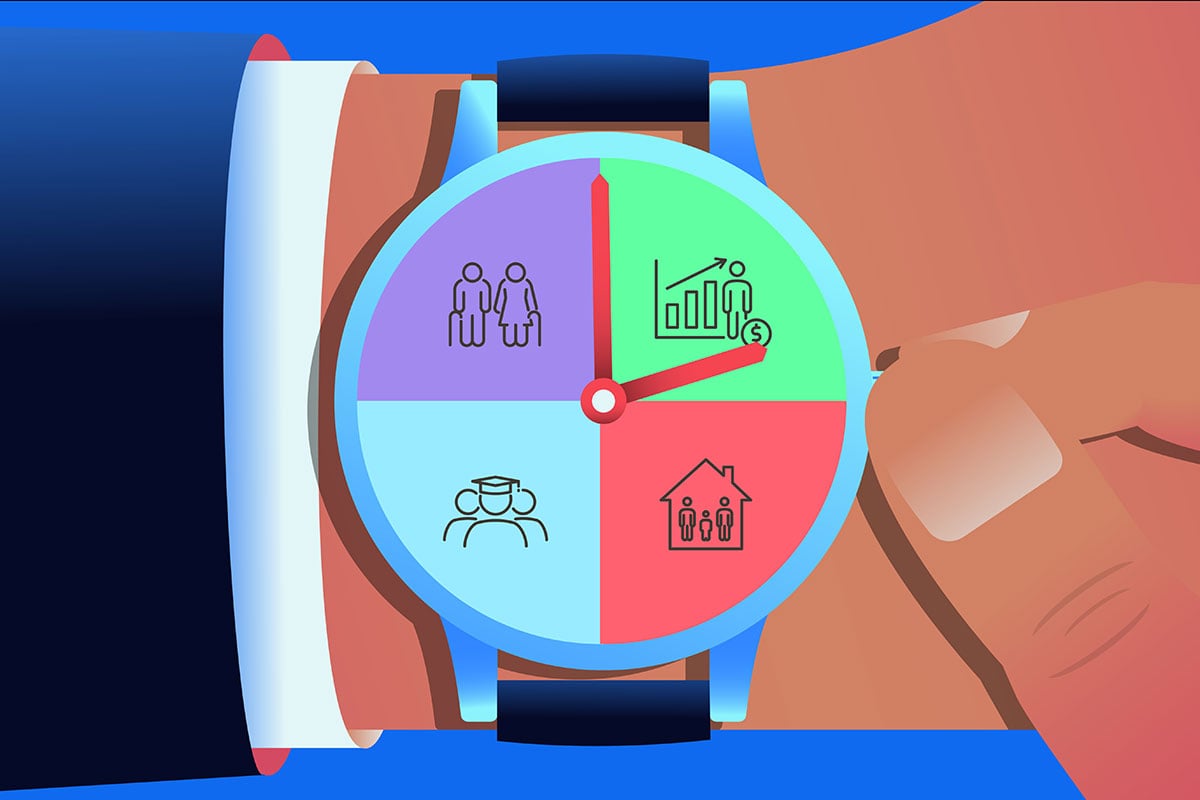
SUMMARY: Your money priorities shouldn’t stay the same forever. From building credit in your 20s to figuring out your legacy in your 50s and beyond, here’s what deserves your attention at every stage of life.
Just like your tastes change as you grow older, your money strategy should, too. After all, your needs as a just-graduated 20-something may be very different than someone who’s approaching 50. Eric Tyson, the author of "Personal Finance for Dummies" explains what you should be focused on as you move from decade to decade throughout your life.
Your 20s
This decade is all about building a solid foundation. That includes building your credit score, thinking about retirement and starting to invest, he says. Here are some tasks to tackle:
- Open your first credit card. You need a good credit score to borrow for a house, car or other big purchases. You also need good credit to rent an apartment, get preferred rates on car insurance and, in some cases, get a job. Open a credit card and always pay on time by turning on automatic payments. Try and pay it off each month to avoid paying interest. Research the different types of cards to fit your needs. The Credit Union has several credit card options to choose from.
- Open a 401K or IRA. If you invest $100 a month starting at age 25, you’ll have more than $535,000 at retirement based on a 10% return rate. The return rate rises exponentially when you invest more.
- Get into the habit of saving money. You’ll also need to set aside money for the unexpected. Cars break down, people lose jobs and fun events pop up. The rule of thumb is to put away a six-month cushion. “It’s a good habit to get into to try to save at least five or 10% of your income and track your spending,” Tyson says. “It may require some sacrifices, but I’ve always been an advocate of people living within their means and saving for tomorrow.”
Your 30s
In your 30s, you might be thinking about buying a home, getting married or starting a family. (The average age of the first-time homebuyer just hit 40.) This means you need to think about the following actions:
- Come up with a down payment. This is where all that saving in your 20s will help. You can also tap 401(k)s since you’ll be paying yourself back.
- Make sure you have the right insurance coverage. Tyson suggests opting for your employer’s long-term disability insurance if it’s offered, making sure you have enough liability insurance through your homeowners and car insurance, and thinking about term life insurance if you have a family.
- Combine finances carefully. When you get married, you need to plan around your spouse’s liabilities and assets. Tyson suggests looking at each other's benefits packages to elect the best, most cost-effective options, figuring out what your joint goals are so you can save toward them, and talking about your risk preferences. One important point: Both partners should take advantage of retirement plans even if one makes more money than the other.
Your 40s
Chances are you may have debt — the average American owes $6,735 in credit card debt and $18,900 in personal loans. You’re also entering your “peak earning years,” Tyson says. This is why in your 40s, you should be focusing on the following goals:
- Pay down debt. If you’re only making minimum payments or feel overwhelmed by what you owe, you can check in with a Credit Union Financial Wellness Program counselor and receive free personalized debt and budgeting coaching.
- Save for your children’s college expenses. As your child gets closer to graduation, it’s important to make sure you’re talking about what your family can afford up front so no one is surprised or disappointed.
- Make necessary mid-career pivots. It’s never too late to make changes if you’re unhappy or unfulfilled. You could even go back to school if you want!
Your 50s and Beyond
As you approach middle age, it’s a perfect time to:
- Do retirement catch-up. Once you turn 50 the IRS lets you make 401K catch-up contributions of up to $8,000 over and above the $24,500 contribution limit for everyone else. You may also want to consider alternate tax-favorable investments like health savings accounts or flexible spending accounts offered by employers, Tyson says.
- Downsize. The median age of repeat homebuyers is 62, and 30% of those homes are purchased with cash. If all your children are grown and flown, you may not need the space or tax burden that comes along with a larger home. It’s also a great time to find a home that’s set up for aging in place.
- Figure out how to leave a legacy. If you’ve amassed money and property, it’s important that you work with an expert so you can pass everything along while minimizing your tax liability.
Tyson says life changes are like skipping stones into a lake. A single event can change everything, he says. “If you throw a pebble into the water, it drops and ripples go in all directions,” he says. “It’s the same with your personal finances.”